
City guide
Living in Larnaca
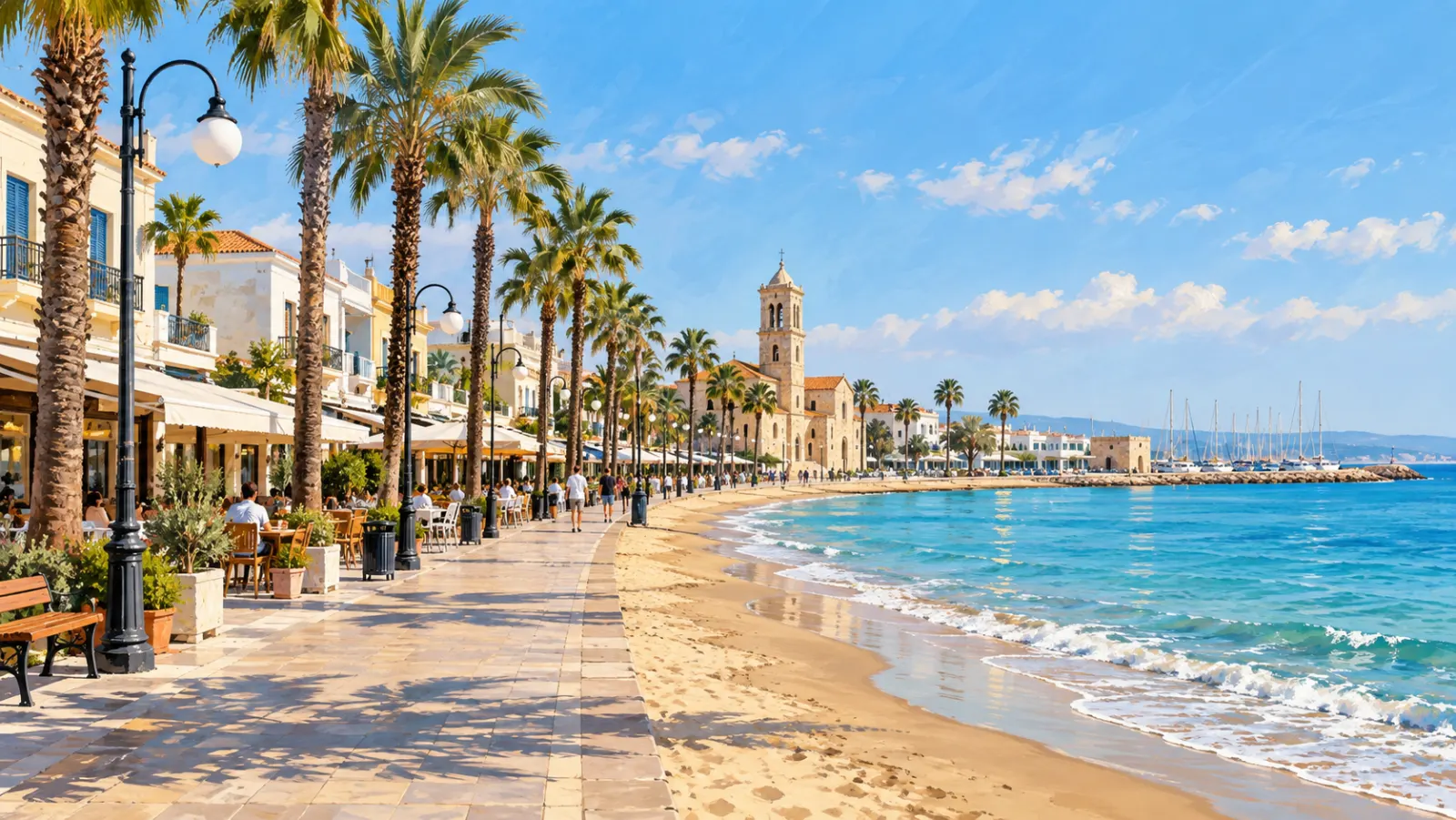
Larnaca hosts the country's primary international airport and has its own long sandy beach, Finikoudes, right against the city centre. It is more low-key than Limassol or Paphos: fewer towers, less polish, more weekday lunch traffic from people who actually live and work in the city.
Areas and everyday life
The district reaches inland through villages like Kiti, Mazotos, Tersefanou and Kornos toward the Mesaoria plain. Larnaca consistently comes out on top for the ratio between price, climate and infrastructure, and its slightly cooler coast makes summers more bearable than in Paphos.
It is the most genuinely mixed city on the island. Expats include British retirees who arrived in the early 2000s, Lebanese and Israeli families with second homes and younger remote workers attracted by lower rents, but the city is still functionally majority-Cypriot. The Russian community is present but not dominant. The Lebanese community, built by families fleeing instability in Beirut, is one of the most established and well-integrated in the country.
Pyla is one of only four mixed Greek-Cypriot/Turkish-Cypriot villages on the island, partly within the UN buffer zone. The Larnaca Port and Marina is undergoing a major mixed-use redevelopment across the late 2020s, alongside the new Larnaca Casino-resort project; expect significant infrastructure improvement to the city centre.
Getting around
The airport is Larnaca's biggest practical advantage: almost every major European airline flies here, often more cheaply than to Paphos, which adds up if you fly back to family in the UK, Greece or Israel several times a year. Public transport within the city is unremarkable, but the airport bus connections are reliable.
Healthcare
Larnaca General Hospital is the main public facility, fully integrated with GeSY. It is less specialised than the larger Nicosia or Limassol public hospitals: for major surgeries and oncology, referrals often go to Nicosia. Private healthcare has expanded fast: ECO Medical Center, Iasis-Larnaca and Apollonion Larnaca cover most outpatient specialties with English-speaking staff and shorter waits than GeSY.
Cardiac and orthopaedic specialists are well-represented locally; complex paediatrics, oncology and neurosurgery still tend to flow toward Mediterranean Hospital in Limassol or the New Nicosia General. Pharmacies are everywhere and reliable. Dental care is private only (€40–€60 cleaning, €700–€1,400 implant). Emergency response is good in the city; from inland villages the nearest A&E may be 20–30 minutes away. 112 works throughout the district.
Schools and childcare
The international school market is smaller than in Limassol or Paphos but growing. The American Academy Larnaca (ages 4 to 18, American-style curriculum, SAT preparation, €4,130 to €7,470 in 2026-27) is the best known. Pascal Private School's Larnaca campus (British curriculum, same ages) is the standard pick for UK-bound students, and The Med High School (12–18) has a tighter academic focus. Several smaller British-curriculum primary schools serve under-12s.
Public Greek-medium schools are free, and the district education authority has been particularly responsive to international families: schools in Pervolia, Kiti and Aradippou increasingly have meaningful expat representation.
Beaches, food and things to do
Finikoudes is lined by a wide pedestrian promenade and the city's main restaurant strip. Mackenzie Beach, ten minutes south near the airport, is the relaxed Blue Flag locals' beach with a continuous strip of beach bars. Cape Greco national park, half an hour east toward the Famagusta area, has sea caves, cliff jumps and good snorkelling.
Thousands of flamingos winter on the salt lake from November to March, and the Hala Sultan Tekke mosque on its shore is one of the most important Islamic pilgrimage sites in Cyprus. Lefkara (lace and silver), Choirokoitia (Neolithic UNESCO site) and the Stavrovouni Monastery are easy day trips. Food is casual: fish tavernas along Piale Pasha, meze houses in the inland villages and a growing specialty-coffee scene around Finikoudes.
Monthly costs
The cheapest of the major Cypriot cities. Sample costs for a couple owning a two-bedroom apartment outright in or near the centre.
| Item | Per month |
|---|---|
| Utilities | €170–€240 |
| Common charges (building with a pool) | €100–€180 |
| Municipal taxes | €25–€40 |
| Groceries (Lidl, Sklavenitis, Alphamega) | €420–€580 |
| Restaurants 3 times a week | €230–€370 |
| One car, all-in | €170–€260 |
| Private health top-up | €70–€140 per person |
| Total | roughly €1,400–€2,050 |
Before discretionary spending. The median asking rent for a two-bedroom apartment in Larnaca district was about €1,200 a month in October 2026 (half of listings between €950 and €1,350; Bazaraki, n=494), well below Limassol. Agreed rents are often lower than asking rents: in July 2026 the Real Estate Registration Council put typical two-bedroom rents at about €1,400–€1,500 in Limassol and €700–€800 in Larnaca and Paphos (Cyprus Mail).
Frequently asked questions
Is the airport noise a problem?
Is the salt-lake area pleasant year-round?
Is Larnaca a good base for families with young children?
Explore Larnaca by topic
Guides, directories and tools for daily life, filtered to Larnaca.