
City guide
Living in Paphos
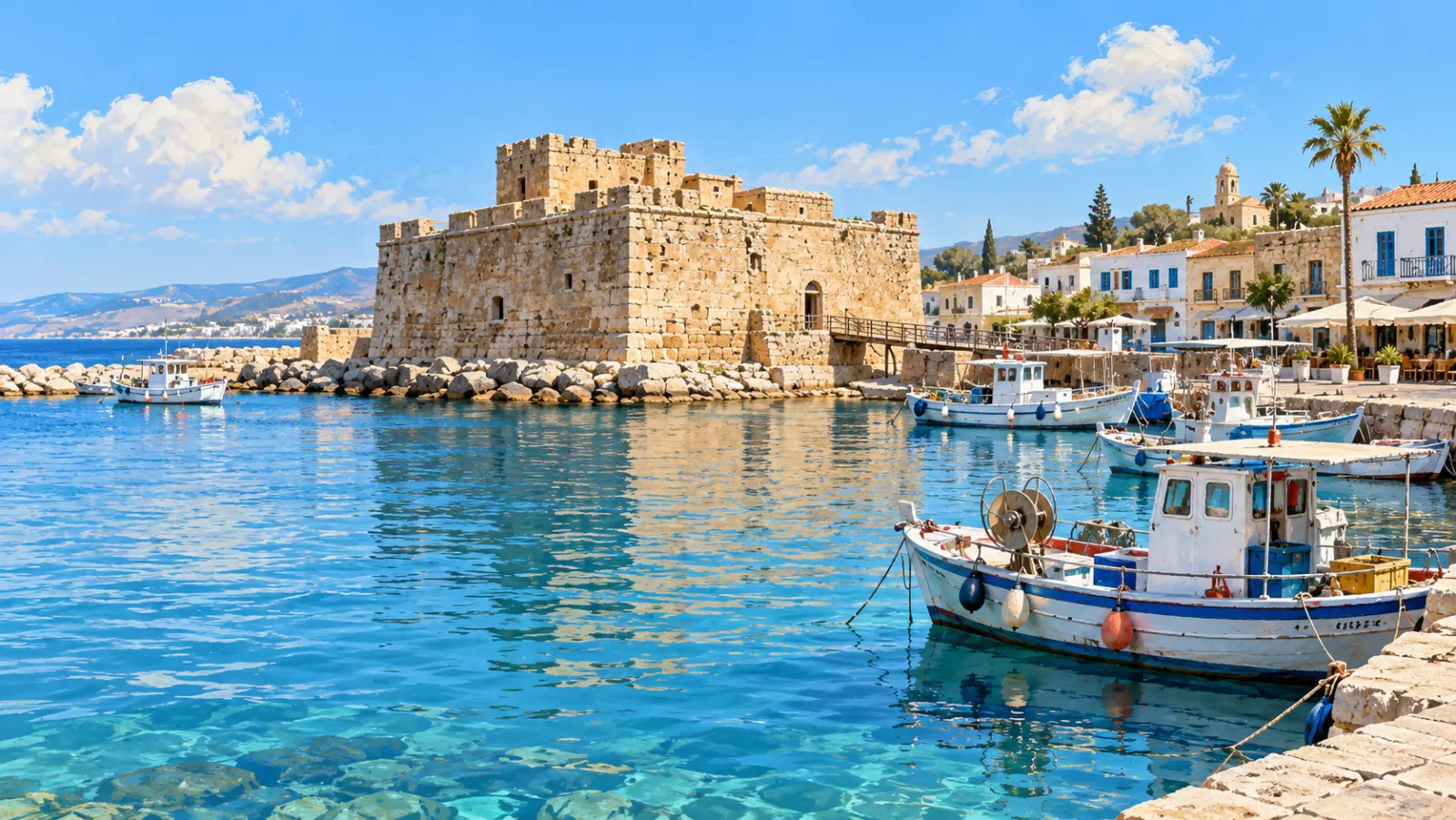
Paphos sits at the south-western tip of Cyprus, where the coast flips between fishing harbour, archaeological park and gentle limestone cliff. It is openly international: about a third of the people at a Saturday market in Kato Paphos won't be Cypriot at all (British, German, Israeli, Lebanese, and increasingly Scandinavian).
Areas and everyday life
The district runs from the Akamas peninsula in the north, one of the last truly wild stretches of Mediterranean coastline, through Polis, Coral Bay and the city, then inland to traditional stone villages in the Troodos foothills.
Paphos skews older and quieter than the rest of the island. A typical newcomer is 50 to 65 and often retired or semi-retired, though families also come for the international schools and the predictable climate. Russian-speaking families used to be the largest non-EU group; since 2022 Israeli families, Ukrainian relocators and a steady trickle from the UK have taken their place.
Life is slower than in Limassol: restaurants close earlier, there's no real club scene, and social life centres on suburban beach restaurants and golf-club terraces. Winter is dramatically quieter (a marina-front block that feels lively in August can feel deserted in February), but a few degrees warmer than Larnaca, with noticeably more sunshine hours.
Getting around
The town runs on cars: local buses cover the coast but are rarely a serious commuting option. Pretty much every long-haul flight from Western Europe lands at Paphos International (PFO).
Healthcare
Paphos General Hospital is the main public facility and part of GeSY, the national healthcare system that most legal residents can register with after immigration formalities (ask the Health Insurance Organisation on 17000 about your own eligibility). Contributions are deducted at source for employees and pensioners; private health insurance is still common but no longer essential.
Iasis Hospital and Evangelistria Medical Center cover most specialties privately, with shorter waits than GeSY for non-urgent referrals. For anything genuinely complex (major cardiac, oncology, neurosurgery) most expats still drive to Limassol or Nicosia. Pharmacies are abundant, English-speaking, and dispense most common UK and EU prescriptions without trouble.
Dental and optical care are private only and reasonably priced (a standard cleaning runs €40–€60). Call 112 in an emergency, as anywhere in the EU; ambulances are fast in central Paphos and occasionally slow in the inland villages.
Schools and childcare
The International School of Paphos is the largest: British curriculum from age 3 to 18, fees from €4,815 (pre-reception and reception) to €9,515 (sixth form) in 2026-27, and a waiting list at the upper end. Aspire Private British School (ages 4–18, ~14 per class, €5,500–€8,500) has a strong reputation among the British and Israeli communities.
Public Greek-medium schools are free, and the education ministry runs a Greek-as-a-second-language programme for newly-arrived expat children. For university, most Paphos teens commute to the University of Cyprus campus in Nicosia or Cyprus University of Technology in Limassol; Neapolis University in Paphos offers psychology, law and business (undergraduate and postgraduate).
Beaches, food and things to do
The coastline is the most varied on the island. Coral Bay, ten minutes north, is the default family beach: a long sandy crescent with shallow water. Lara Bay in the Akamas is a protected turtle nesting site reachable only by 4x4. Petra tou Romiou (Aphrodite's Rock) is on the road east toward Limassol, and Latchi, near Polis, runs daily Blue Lagoon boat trips into the Akamas in summer.
Inland, the Paphos Forest, the Troodos villages (Lofou, Omodos, Phyti) and the Aphrodite Hills resort make easy weekends. Dining is casual, with long lunches at fish tavernas in Mandria, Pomos and Latchi rather than late nights. Three golf courses (Aphrodite Hills, Secret Valley, Minthis) are in this district, more than the rest of Cyprus combined.
Monthly costs
A comfortable but unflashy 2026 budget for a couple owning a two-bed new-build apartment outright. Paphos is consistently the second-cheapest major city after Larnaca.
| Item | Per month |
|---|---|
| Utilities (electricity, water, internet, mobile) | €180–€250 |
| Common charges (development with a pool) | €120–€200 |
| Municipal taxes and refuse | €25–€40 |
| Groceries for two | €450–€600 |
| Eating out 3 times a week | €250–€400 |
| One car, all-in | €180–€280 |
| Private health top-up | €80–€140 per person |
| Total | roughly €1,500–€2,200 |
Before travel, schooling and larger discretionary spending; utilities vary with aircon use. Lidl is the cheapest chain; Sklavenitis and Alphamega are the main full-range supermarkets. The median asking rent for a two-bedroom apartment in Paphos district was about €1,500 a month in October 2026 (half of listings between €1,200 and €2,000; Bazaraki). Agreed rents are often lower than asking rents: in July 2026 the Real Estate Registration Council put typical two-bedroom rents at about €1,400–€1,500 in Limassol and €700–€800 in Larnaca and Paphos (Cyprus Mail).
Frequently asked questions
Is English widely spoken?
Practical notes
- 1 Gbps fibre is available across the urban area, which makes Paphos particularly attractive to remote workers.
- Inland stone villages can lack the road, water, internet and emergency-services infrastructure of the coast. Stay overnight first and check mobile signal, fibre and supermarket distance.
Explore Paphos by topic
Guides, directories and tools for daily life, filtered to Paphos.