
City guide
Living in Limassol
Limassol is the second largest city in Cyprus and, by a wide margin, the most dynamic. Strung along about fifteen kilometres of southern seafront, it is home to the shipping industry, most of the tech and fintech employers, and the island's largest concentration of international families.
Areas and everyday life
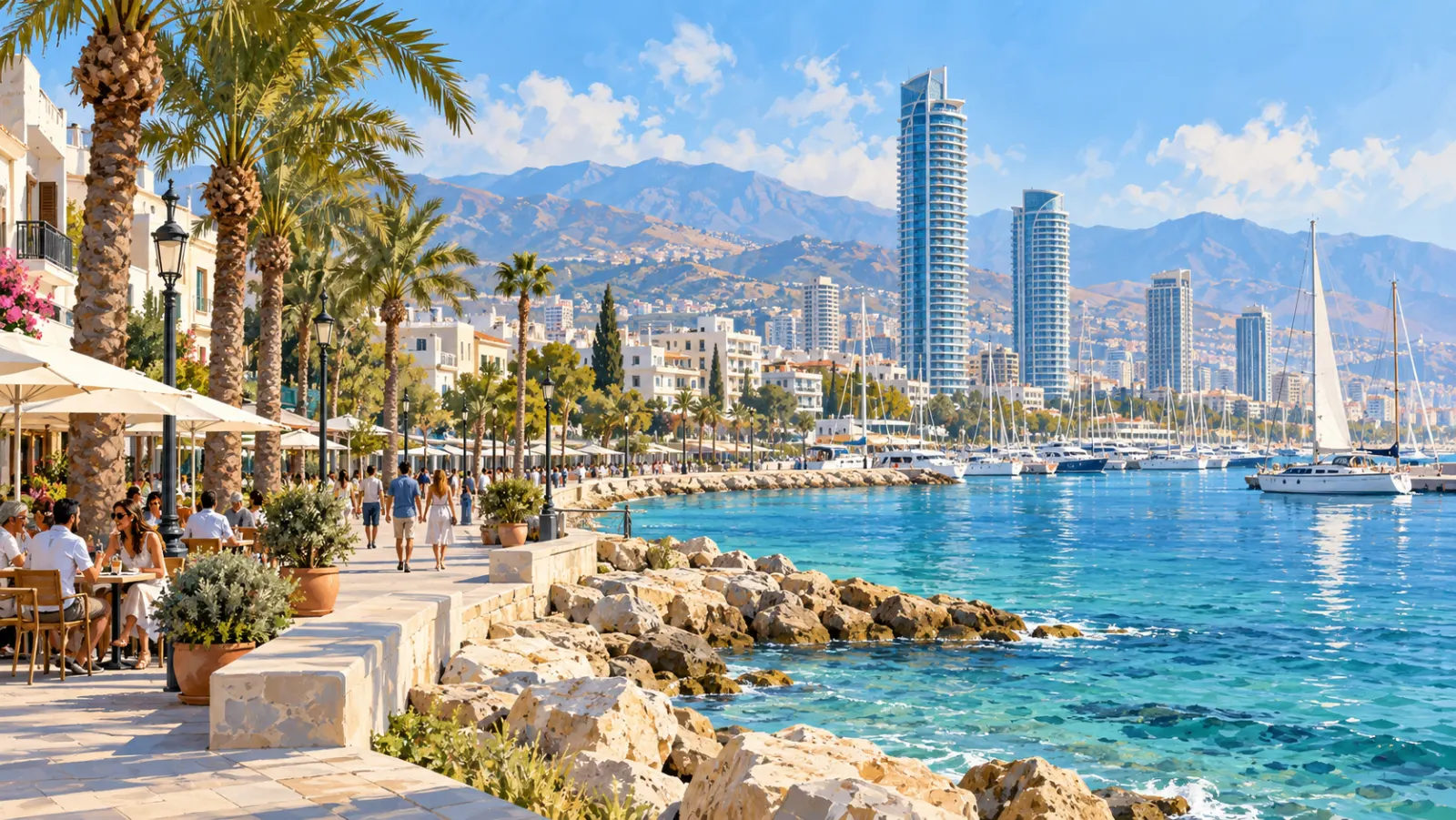
The skyline has changed more in five years than in the previous fifty: half a dozen 30-plus-storey towers (mostly on a 1.5 km strip in Neapolis and Agios Tychon), a marina, a casino resort and constant mid-rise building behind the seafront. Neapolis, Germasogeia and central Limassol are the desirable central areas; Ypsonas, Polemidia and Erimi are 30–50% cheaper for equivalent space, 15–25 minutes from the centre.
If you move to Cyprus to work for a company, you almost certainly land here. Newcomers average 30 to 45 and are almost always working: Wargaming, Revolut, eToro, Exness, NEXTEN, JetBrains, the shipping firms and many forex brokers and crypto outfits have substantial Limassol headcount. The city is heavily Russian-speaking (a legacy of two decades of Russian investment), but the workforce is international: Greek, French, Israeli, Indian, South African. The social pace is genuinely European, with late dinners and busy bars on weekday evenings.
Getting around
Limassol has no airport: most expats use Larnaca (40 minutes east, the main international gateway) or Paphos (60 minutes west). City buses are improving but most expats drive; InterCity coaches to Larnaca and Paphos cost €5 one way.
Traffic is the main complaint. The city sprawls along a thin coastal strip with one main road, and rush hour through Germasogeia and the Old Town can turn a 10-minute Google Maps trip into 30 minutes. Test regular drives at 8:30 AM and 6:00 PM; living within walking distance of the seafront promenade or your employer avoids 80% of that pain.
Healthcare
Limassol has the best private hospital infrastructure on the island. Mediterranean Hospital of Cyprus is the largest and most internationally certified; the German Oncology Center handles cancer treatment that previously sent patients abroad; Ygia Polyclinic, Limassol General (public, GeSY) and Apollonion-Limassol cover most specialties.
GeSY registration is straightforward for legal residents and gives you a personal doctor and specialist referrals, mostly without out-of-pocket cost. Non-urgent specialist waits can run weeks, so many expats keep private cover: typically €80–€180 a month for an adult under 50. Dental care is private only: €40–€80 for a cleaning, €600–€1,200 for a single implant. English-fluent specialists are easy to find in almost any field; many physicians trained in the UK.
Schools and childcare
Limassol has the strongest international schools in Cyprus, plus several Greek private schools and public schools that increasingly accommodate international children. The Heritage Private School (Palodia) is the most prestigious: British curriculum from 3 to 18, IB Diploma at sixth form, €7,020 to €13,200 a year (2026-27), and up to a 12-month wait for senior years. Foley's (€8,400 to €12,600) and The Grammar School Limassol (secondary only, €8,700 to €10,650 for non-Cypriot pupils) have strong A-level results. The American Academy Limassol teaches an American curriculum to AP level. Several private Russian schools remain, though enrolment has dropped sharply since 2022.
Some new residential complexes have kindergartens on-site. The University of Limassol opened in 2022 as a private campus; Cyprus University of Technology (CUT) is the main public university.
Beaches, food and things to do
Akti Olympion runs the length of the central tourist strip: sandy, clean, lifeguarded and shallow, with a continuous promenade. Lady's Mile, west of the port, is the locals' beach: five kilometres of dark sand, a few beach bars, easy parking and the tech workforce at weekends. Governor's Beach (fifteen minutes east) has white limestone cliffs and is calmer; Pissouri (thirty minutes west) is the prettiest in the district.
Limassol has the island's strongest restaurant and nightlife scene, City of Dreams Mediterranean (the largest casino in Europe), the Limassol Marina (yacht charter, harbour-side restaurants, art exhibitions), the Pattichion theatre and a growing gallery district. The Troodos villages are close for wine tastings, mountain biking and weekend skiing in winter.
Monthly costs
The most expensive city in Cyprus. Sample costs for a couple owning a two-bedroom apartment outright in Neapolis, Germasogeia or central Limassol.
| Item | Per month |
|---|---|
| Utilities | €220–€320 |
| Tower common charges (lifts, gym, pool, security) | €250–€500 |
| Municipal | €30–€50 |
| Groceries | €500–€700 |
| Restaurants 3–4 times a week | €400–€700 |
| One car, all-in | €200–€300 |
| Private health top-up | €100–€180 per person |
| Total | roughly €1,900–€2,950 |
Rent is extra: the median asking rent for a two-bedroom apartment in Limassol district was about €2,200 a month in October 2026, and half of listings asked between €1,800 and €3,000 (Bazaraki, n=1,292). That median is about 47% above Paphos and 83% above Larnaca, and the most expensive seafront towers ask several times the median. Agreed rents are often lower than asking rents: in July 2026 the Real Estate Registration Council put typical two-bedroom rents at about €1,400–€1,500 in Limassol and €700–€800 in Larnaca and Paphos (Cyprus Mail). Limassol has consistently topped Cyprus's cost-of-living index, and newcomers consistently underestimate the gap.
Frequently asked questions
Is Limassol a good base for remote work?
How safe is Limassol?
What about earthquakes and regional tension?
Explore Limassol by topic
Guides, directories and tools for daily life, filtered to Limassol.